/

/

Sumter

Sumter

Recurrent Energy is developing a large-scale solar energy project in Sumter County, Georgia north of Americus. Recurrent Energy expects to install up to 150 megawatts (MW) of solar on the site using photovoltaic solar panels, which has the potential to power over 32,000 homes each year, boost economic development, and significantly increase tax revenue for public services in Sumter County once the project is in operation, which is expected to be late 2023.

Project Details
LocationSumter County, Georgia, United States
Project Capacity150 MWp
Homes PoweredOver 32,000 annually
Targeted Operation DateQ4 2023
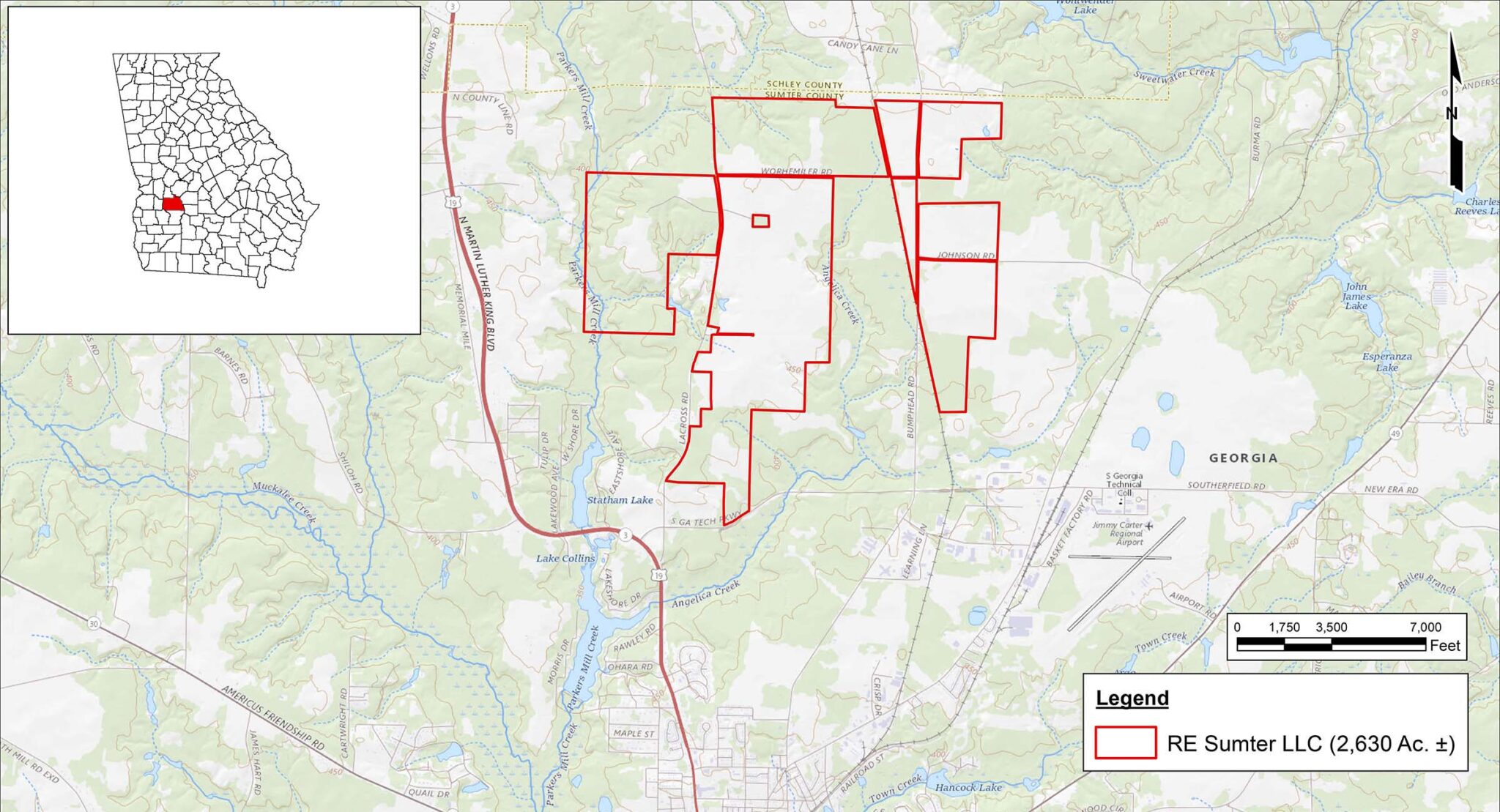
Acreage2,876 acres with project infrastructure located on approximately 1,300 acres
InterconnectionTBD
CustomerTBD
Est. Jobs CreatedUp to 350 during construction and 2-4 jobs during the operation period
Estimated TaxesOver $10MM
Earliest Construction Start DateTBD
FAQs
How much land will be needed for the Sumter Solar Project?

The Sumter Solar Project will require 2,876 acres of land, with project infrastructure located on approximately 1,300 acres. Sumter County comprises over 309,000 acres of land, so project infrastructure will be located on less than 0.5% of Sumter County’s total acreage yet will generate enough energy to power 32,000 homes annually. The Sumter Solar Project will generate over $10 million of long-term additional revenue to Sumter County over the project’s anticipated operational life. The significant tax increase will improve local schools, emergency services, and other infrastructure improvements.

Do solar projects make economic sense?

In the last decade, the cost to install solar has dropped by more than 70%, and as of Q3 2019, prices are at their lowest historical level across all market segments. Due to continuing technological innovations, new utility-scale solar energy projects are now often cost-competitive with new natural gas generation. In fact, new solar projects are often cheaper than both coal and natural gas. Because solar PV is a technology and not a fuel (like oil, gas and coal), costs will continue to decline as research continues to improve existing technology.

Are solar panels safe?

Because the photovoltaic (PV) panel materials are enclosed and do not mix with water or vaporize into the air, there is little-to-no risk of chemicals, including greenhouse gasses, being released into the environment during normal use. Crystalline silicon PV panels, which are extremely common and used worldwide, “do not pose a material risk of toxicity to public health and safety.”

All solar facilities are designed to strict electrical safety standards to ensure safe operation. Product safety standards, installation requirements, and building codes for solar facilities are addressed by the National Fire Protection Agency’s National Electric code, the International Code Council’s International Fire Code, the International Association of Firefighters, and several other safety product and standards groups.

What steps will you take to prevent trespassing in the project area?

The National Electric Code requires appropriate levels of warning on all electrical components. The Sumter Solar Project will be surrounded by a fence at least six feet in height with three strands of barbed wire in accordance with the Sumter County code. Along with the security fencing, the vegetative buffer will also deter trespassers.

Will glint or glare from sunlight be an issue?

Glint refers to the direct reflection of the sun on a solar panel. Glare is a continuing source of brightness, not the direct reflection of the sun. Solar arrays are designed to absorb light and produce electricity, not reflect it. The panels that we will use for the Sumter Solar Project have an anti-reflective coating, which helps to increase the amount of light absorbed into the cell, thereby increasing efficiency and reducing glare and allowing the panels to blend in more easily with the surrounding area. If the project site is near an airport, we are required to submit a filing to the FAA, at which point it will be determined if a glare study needs to be conducted. Moreover, the landscaping around the perimeter of the project will buffer any glint and glare that may be produced.

How frequently will the property be monitored?

The Sumter Solar Project will be monitored during operating hours by onsite staff. The entire property will also be monitored remotely 24 hours a day, 7 days a week.

Will the Sumter Solar Project affect my property value?

Examining property values across the United States demonstrates that large-scale solar projects like the Sumter Solar Project have no measurable impact on the value of the adjacent properties, and in some cases, may even have positive effects. Studies also show that proximity to solar projects does not deter the sales of agricultural or residential land.

How will the vegetation within the property be maintained?

Our screening and vegetation management activities will conform to Sumter County’s ordinance. Maintenance crews will maintain the perimeter and interior landscaping within the project boundaries. The interior ground cover shall not exceed 18 inches, with a typical maximum height of 12 inches, so that it doesn’t interfere with the panels or other electrical components.

Why use barbed wire fencing?

The fencing materials are required by the Sumter County Code.

Are solar projects good for the environment?

While producing electricity with photovoltaics emits no pollution, produces no greenhouse gas emissions, and uses no finite fossil fuel resources, it has been argued that solar power has a hidden carbon footprint due to solar panel manufacturing and project construction. Both fossil fuel and non-fossil fuel power technologies induce life-cycle greenhouse emissions that stem from the energy requirements for their construction and operation. Known as a “carbon debt,” this debt of energy must be paid off to calculate how solar projects reduce emissions over their lifetime. A typical utility-scale solar project—like the Sumter Solar Project—repays its carbon footprint in roughly 12 months or less, providing decades of zero emission energy.

How will this project affect Sumter County wildlife?

If sited and developed properly, the installation of a solar facility will have minimal impacts on wildlife in the area. In fact, studies show that solar facilities can provide shelter for species, promote land stability, preserve habitat, and support biodiversity.

A biological study has been performed on the Sumter Solar Project site, in which onsite and/or downstream habitat was identified for four federally listed bivalve species and nine state-listed species, all of which are water dependent. We are currently coordinating with the U.S. Fish and Wildlife Service and the Georgia Department of Natural Resources. No impacts to jurisdictional waters are anticipated, and a concurrence of “no effect” is anticipated from both agencies regarding these species.

Once constructed, solar projects produce no pollution, emissions, or noise. Further, native vegetation can grow under the panels, and solar facilities can provide sanctuaries for flora and fauna to thrive.

Limited fencing, a security measure put in place in accordance with industry best practices and local requirements, will be erected around panel areas, but waterways in the project area will not be fenced to allow continued wildlife access to the water resource.
What are you doing to protect the wetlands?

An onsite wetland delineation study of the project area was completed in accordance with the 1987 U.S. Army Corps of Engineers Wetlands Delineation Manual and the 2010 Regional Supplement to the U.S. Army Corps of Engineers Wetland Delineation Manual: Atlantic and Gulf Coastal Plain (Regional Supplement). The study identified all wetlands on site, and the Sumter Solar Project site design was adjusted such that there is a 25-foot buffer between project infrastructure and aquatic features depicted on the site plan.

Will leakage occur?

The construction of the Sumter Solar Project will not require toxic chemicals or processes. Photovoltaic (PV) panels typically consist of glass, aluminum, copper, silver, and semiconductor materials that can be successfully recovered and reused. Because the PV panel materials are enclosed and do not mix with water or vaporize into the air, there is little-to-no risk of chemicals, including greenhouse gases, being released into the environment during normal use. Chrystalline silicon PV panels, an extremely common panel variant used around the world, “do not pose a material risk of toxicity to public health and safety.

In addition, to provide decades of corrosion-free operation, panels like the ones that will be used for the Sumter Solar Project, are encapsulated from air and moisture between two layers of plastic. The encapsulation layers are further protected with a layer of tempered glass on the front and a polymer sheet on the back. For decades, this same material has been used between layers of tempered glass to give car windshields and hurricane windows their great strength, allowing them to stay intact even if damage occurs.

What happens to the rain when it hits the panels?

The Sumter Solar Project will use a solar panel tracking system, allowing the reflective surfaces to align with the sun as it moves across the sky. Therefore, due to continuous tilt, water will not collect on the panels during rainstorms. The rainwater that runs off the panels is absorbed into the ground, nurturing the groundcover. Any excess rainwater leaves the site as stormwater runoff, just as it does now.

How will the panels be washed? Will you use ground water?

Due to the average amount of rainfall Sumter County normally experiences, we do not anticipate washing the panels. However, if washing is required, when cleaning the solar panels, we will use distilled water, because ground water can leave a film or deposits on the panels.  No chemicals or solvents will be used during the panel cleaning process.

How will decommissioning work?

The Sumter County ordinance requires that the Sumter Solar Project submit a detailed decommissioning plan prior to construction. These plans have given elected officials throughout Georgia and the nation confidence in approving these long-term infrastructure projects. Decommissioning will include removal of all materials related to the project and its operation, including access roads and electrical equipment. At the end of the project’s operational life, the land can be returned to its prior natural condition.

Can solar panels be recycled?

Photovoltaic (solar) panels typically consist of glass, aluminum, copper, silver and semiconductor materials than can be successfully recovered and reused at the end of their useful life. Alternatively, solar PV components can be reused or refurbished to have a “second life” of generating electricity.

What provisions will be made to guarantee that the funds are in place when it is time to decommission the facility?

The Sumter Solar Project is required by the Sumter County ordinance to fully fund a cash or surety bond to cover the full cost of decommissioning. This financial assurance must be in place before construction begins and stays with the project throughout its lifetime.

Can the land return to agricultural use after decommissioning?

At the time of construction, the land on which the Sumter Solar Project is sited will be rezoned for industrial use, as required by Sumter County laws, but will still allow for agricultural activity. Therefore, the land can revert to agricultural use after decommissioning occurs at the end of the project’s life.

Solar projects are low impact and coexist well with agriculture, operating without any impact to adjacent agricultural properties. A solar project’s lifespan allows the soil in the project area to rest and rebuild. Native vegetation can grow under the panels, allowing the land to retain water and topsoil, improving soil health over time.

Are you buying or leasing the land for the Sumter Solar Project?

We enter long-term agreements with landowners, who host our solar power equipment in exchange for a long-term, predictable revenue stream. Leasing the land allows landowners to retain ownership of their property and continue to use the portions of land that do not contain project infrastructure.

Our lease agreements are legally binding and include protections for landowners to ensure payments are received, beginning shortly after signing the agreement and continuing throughout the project’s operating life. In addition, our lease agreements require us to remove all equipment and restore the land to its original condition at the end of the project’s life.

Will concrete be used around the piles holding up the panels?

There will be no concrete poured around piles holding up tracker rows. There will be limited amounts of concrete for inverter pads and at the substation.

What will you do to maintain traffic safety during construction and once the site is running?

The Sumter Solar Project will be designed in accordance with GDOT safety guidelines. Signage and flagging will be implemented during construction as required. After construction is complete, the daily traffic will be reduced to one or two standard-size vehicles.

What is the anticipated regular construction schedule?

We anticipate that the Sumter Solar Project will have a 12-month construction timeline. Construction will only occur during daylight hours Monday-Friday, and some work may occur on Saturdays. We do not anticipate construction activities taking place on Sundays.

What will you do to protect the topsoil from being depleted during construction?

The Sumter Solar Project will use construction methods that minimize large-scale grading and removal of native soil. Minor grading may be needed, but we take the conservation of topsoil very seriously. Typical construction practices require that topsoil be stripped and preserved onsite prior to performing cut/fill operations. The preserved topsoil will be redistributed across the graded areas to assist in growing adequate ground cover as quickly as possible to provide ground stabilization. The site cut and fill will be appropriately balanced, with no anticipation of import/export necessary.