Recurrent Energy owns and operates the North Fork Solar Project, a 160 MWp solar photovoltaic power generation facility in Kiowa County, Oklahoma. North Fork Solar has been fully operational since 2024.
Recurrent Energy owns and operates the North Fork Solar Project, a 160 MWp solar photovoltaic power generation facility in Kiowa County, Oklahoma. North Fork Solar has been fully operational since 2024.
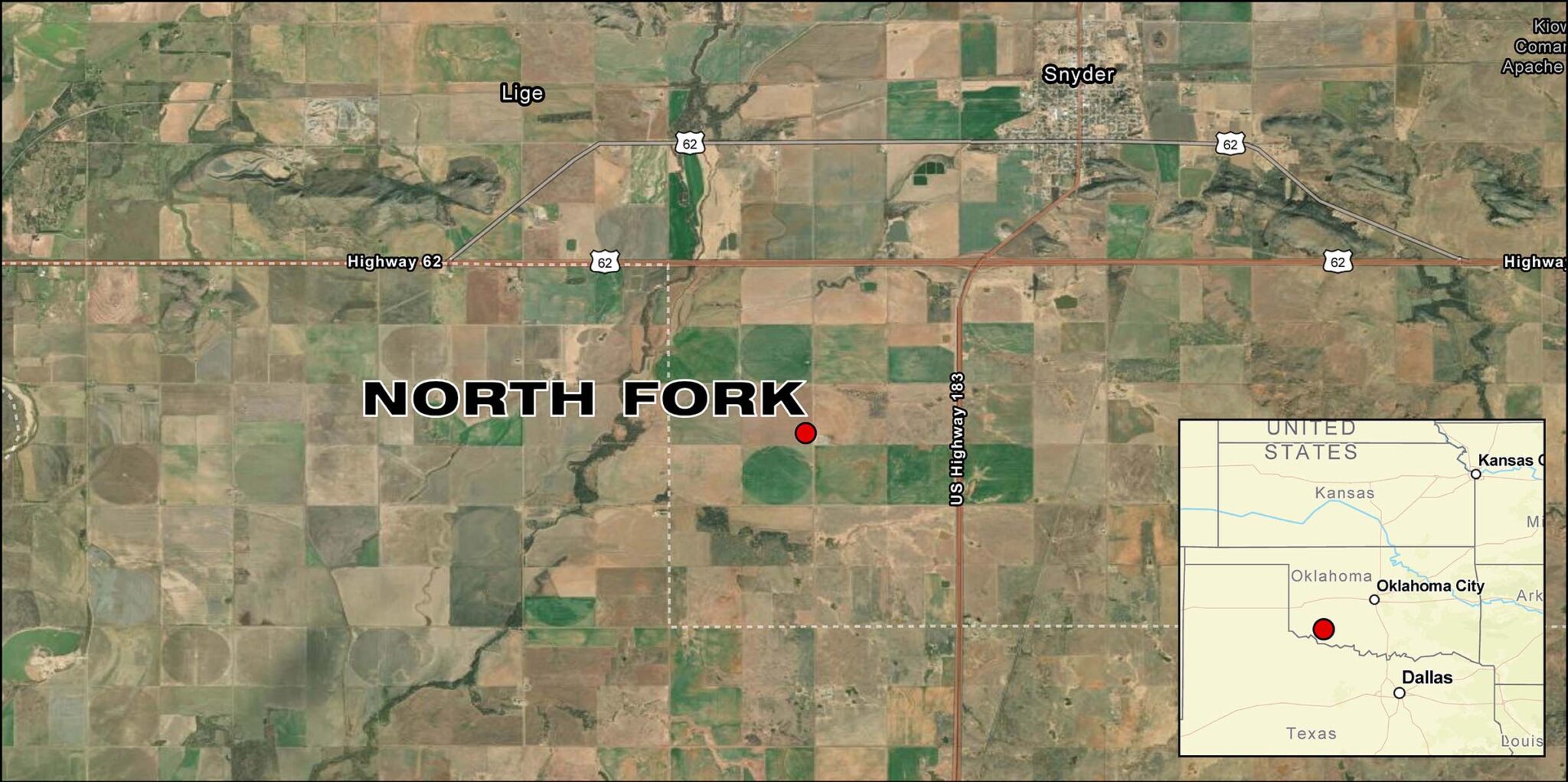
| Technology | Solar |
| Location | Oklahoma, United States |
| Project Capacity | 160 MWp |
| Homes Powered | Approximately 35,000 homes annually |
| Targeted Operation Date | June 2024 |
| Acreage | Approximately 1,012 acres |
| Interconnection | June 2024 |
| Customer | Oklahoma Municipal Power Authority (OMPA) |
| Est. Jobs Created | Est. Jobs Created: Approximately 250 jobs during peak construction and 3 jobs during the operation period |
| Estimated Taxes | TBD |
| Earliest Construction Start Date | August 2023 |
In the last decade, the cost to install solar has dropped by more than 50% and has experienced an average annual growth rate of 33%. According to Lazard’s Levelized Cost of Energy Analysis – Version 16.0 (2022), even without tax credits, new solar resources have a levelized cost of energy in the range of 2.4 cents/kWh – 9.6 cents/kWh for large-scale solar. Solar projects generate electricity at a lower cost per megawatt hour than would other possible fossil fuel and most renewable energy options. These results have been bolstered by the International Energy Agency’s World Energy Outlook 2021, which found, “in most markets, solar PV or wind now represents the cheapest available source of new electricity generation.” Because solar PV is a technology and not a fuel (like oil, gas and coal), costs will continue to decline as research continues to improve existing technology.
Because the photovoltaic panel materials are enclosed and do not mix with water or vaporize into the air, there is little-to-no risk of chemicals, including greenhouse gasses, being released into the environment during normal use. Crystalline silicon PV panels, which are extremely common and used worldwide, “do not pose a material risk of toxicity to public health and safety.”
All solar facilities are designed to strict electrical safety standards to ensure safe operation. Product safety standards, installation requirements, and building codes for solar facilities are addressed by the National Fire Protection Agency’s National Electric code, the International Code Council’s International Fire Code, the International Association of Firefighters, and several other safety product and standards groups.
The National Electric Code requires appropriate levels of warning on all electrical components. The North Fork Solar Project will be surrounded by a fence at least six feet in height, with three strands of barbed wire on top as an added protection measure.
Glint refers to the direct reflection of the sun on a solar panel. Glare is a continuing source of brightness, not the direct reflection of the sun. Solar arrays are designed to absorb light and produce electricity, not reflect it. The panels that we will use for the North Fork Solar Project have an anti-reflective coating, which helps to increase the amount of light absorbed into the cell, thereby increasing efficiency and reducing glare and allowing the panels to blend in more easily with the surrounding area.
The North Fork Solar Project will be monitored during operating hours by onsite staff. The entire property will also be monitored remotely 24 hours a day, 7 days a week.
Examining property values across the United States demonstrates that large-scale solar projects like the North Fork Solar Project have no measurable impact on the value of the adjacent properties, and in some cases, may even have positive effects. Studies also show that proximity to solar projects does not deter the sales of agricultural or residential land.
Maintenance crews will maintain the perimeter and interior landscaping within the project boundaries, so that it doesn’t interfere with the panels or other electrical components.
While producing electricity with photovoltaics emits no pollution, produces no greenhouse gas emissions, and uses no finite fossil fuel resources, it has been argued that solar power has a hidden carbon footprint due to solar panel manufacturing and project construction. Both fossil fuel and non-fossil fuel power technologies induce life-cycle greenhouse emissions that stem from the energy requirements for their construction and operation. Known as a “carbon debt,” this debt of energy must be paid off to calculate how solar projects reduce emissions over their lifetime. A typical utility-scale solar project—like the North Fork Solar Project—repays its carbon debt in roughly 12 months or less, providing decades of zero emission energy.
The following studies, documents, and permits were completed before construction of the North Fork Solar Project and meet the expectations of a third-party Independent Engineer (IE):
When sited and developed properly, the installation of a solar facility will have minimal impacts on wildlife in the area. In fact, studies show that solar facilities can provide shelter for species, promote land stability, preserve habitat, and support biodiversity.
Natural resource assessments have been conducted on the North Fork Solar Project site to determine presence, if any, of federally or state listed species and critical habitat. The assessments concluded that the project area does not contain habitat suitable for federally listed species with potential to occur in the Project Area. As a voluntary measure, coordination was completed with the US Fish and Wildlife Service (USFWS) to identify voluntary best management practices that the project could implement to avoid impacts to federally listed species. As a result of this coordination, the project has committed to several best management practices (BMP) to minimize impacts to the federally listed Whooping Crane, which are known to migrate through Kiowa County. These BMPs include marking existing transmission lines with bird diverters, reduction of skyward illumination, and implementing a workers environmental awareness plan during construction.
As an additional measure aimed at protecting Kiowa County wildlife, the project is implementing a Migratory Bird and Eagle Conservation Plan which includes additional avoidance and minimization measures expected to reduce avian risk.
The project will include the planting of a site-specific native seed mix containing a wide variety of native grasses common to the region. By incorporating native plant species throughout the project area, it is expected that the project will contribute to soil health and fertility, wildlife habitat, and forage areas.
A wetland delineation was performed on the North Fork Solar Project site. Coordination with U.S. Army Corps of Engineers determined that no waters of the US are located within the project area. As a voluntary measure, the project will maintain at least a 60-foot setback from all identified aquatic features. The project is also implementing a stormwater pollution prevention plan which includes BMPs designed to avoid impacts to surface water quality.
The construction of the North Fork Solar Project will not require toxic chemicals or processes. PV panels typically consist of glass, aluminum, copper, silver, and semiconductor materials that can be successfully recovered and reused. Because the PV panel materials are enclosed and do not mix with water or vaporize into the air, there is little-to-no risk of chemicals, including greenhouse gases, being released into the environment during normal use. Crystalline silicon PV panels, an extremely common panel variant used around the world, “do not pose a material risk of toxicity to public health and safety.”
In addition, to provide decades of corrosion-free operation, panels like the ones that will be used for the North Fork Solar Project, are encapsulated from air and moisture between two layers of plastic. The encapsulation layers are further protected with a layer of tempered glass on the front and a polymer sheet on the back. For decades, this same material has been used between layers of tempered glass to give car windshields and hurricane windows their great strength, allowing them to stay intact even if damage occurs.
The North Fork Solar Project will use a solar panel tracking system, allowing the reflective surfaces to align with the sun as it moves across the sky. Therefore, due to continuous tilt, water will not collect on the panels during rainstorms. The rainwater that runs off the panels is absorbed into the ground, nurturing vegetation located under the panels. All stormwater on the site will be managed by a stormwater management system, which will be protective of local water quality.
Due to the average amount of rainfall Kiowa County normally experiences, we do not anticipate regularly scheduled washing of the panels. However, if washing is required, locally sourced water will be used to clean the modules.
PV panels typically consist of glass, aluminum, copper, silver and semiconductor materials than can be successfully recovered and reused at the end of their useful life. Alternatively, solar PV components can be reused or refurbished to have a “second life” of generating electricity.
Solar projects are low impact and coexist well with agriculture, operating without any impact to adjacent agricultural properties. A solar project’s lifespan allows the soil in the project area to rest and replenish nutrients. Native vegetation can grow under the panels, allowing the land to retain water and topsoil, improving soil health over time. After decommissioning occurs at the end of the Project’s life, the land can revert to its previous agricultural use.
There will be no concrete poured around piles holding up tracker rows. There will be limited amounts of concrete for inverter pads and at the substation.
The North Fork Solar Project will be designed in accordance with Oklahoma Department of Transportation safety guidelines. Signage and flagging will be implemented during construction as required. After construction is complete, the daily traffic will be reduced to one or two standard-size vehicles.
We anticipate that the North Fork Solar Project will have a 10-month construction timeline. Construction will only occur during daylight hours Monday-Friday, and some work may occur on Saturdays. We do not anticipate construction activities taking place on Sundays.
The North Fork Solar Project will use construction methods that minimize large-scale grading and removal of native soil. Minor grading may be needed, but we take the conservation of topsoil very seriously. Typical construction practices require that topsoil be stripped and preserved onsite prior to performing cut/fill operations. The preserved topsoil will be redistributed across the graded areas to assist in growing adequate ground cover as quickly as possible to provide ground stabilization.